

Ouachita Parish
LAGenWeb

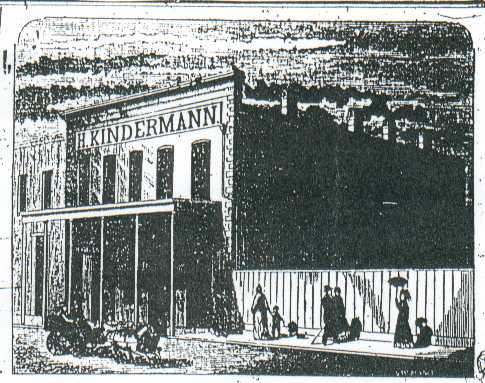 The above [now to the right] is an illustration of one of the principal business houses on
DeSiard street, that of Henry Kindermann, the popular family grocery merchant.
The building was erected in 1873 on the site of a large wooden store burned down
the same year, has a front of 44 feet with a depth of 100 feet, and is provided
with an elevator and a cellar. The cost of erection was $7,500.
A brief
sketch of the business career of Mr. Kindermann will not be amiss in this
connection.
Henry Kindermann came from Prussia in 1855, landing at New
Orleans. He had, in cash, only one Prussian thaler -- about 70 cents -- and of a
knowledge of the English language, none. Neither had he any relatives, or any
acquaintances in this country, but was, in sober truth and stern reality, a
stranger in a strange land. But Henry had determination, and was willing to take
anything, as he has expressed it, that would offer itself to him in the way of
honest work. He had $2.00 advanced to him in New Orleans to go out on the
Jackson railroad in search of work. Four miles from Ponchitoula station
Kindermann found employment on a farm at $6.00 a month, at which he worked five
months longer, and then returned to New Orleans to work in a store.
In
December, 1857, Mr. Kindermann came to Monroe, and was employed as a clerk by
Mr. E. S. Austin. The year following, he embarked in business for himself with a
capital of $150, doing a grocery business, in which he was "boss," clerk,
drayman, and porter. His first year's sales amounted to perhaps $1,000. But
energy and strict attention to business brought custom, and Kindermann began
rising, not rapidly, but by steady steps, and at the outbreak of the war was
comparatively prosperous. Not being a citizen, either by birth, or
naturalization, he returned to Germany during the war, not wishing to enter the
army, or to remain and engage in business speculations, opportunities to do
which were then abundant.
The war closing, Mr. Kindermann returned, and,
with Mr. J.G. Sanders, again embarked in business. In 1867, Mr. K. purchased the
lot upon which the building shown in the engraving stands, and erected thereon a
wooden storehouse. It was then away out on DeSiard street, and stood alone.
There was not then another business house on that street, proper, from grand
street to the woods -- or, rather, the cemetery, then the limit of the street --
and now there are thirty, or more. Kindermann's foresight and the city's
development, it would seem, were members of the same conspiracy. The wooden
building was destroyed by fire in May, 1873. In November following, Kindermann's
present store (which is, also, his residence where he is comfortably at home)
was erected. Mr. Kindermann has been steadily and quietly attending the wants of
his customers and the demands of trade since the erection of his new house,
losing none of his energy or his urbanity, nor abating in push and vim a
particle since the days when he would sell a few articles and trundle them to
his customer's home in a wheelbarrow. In fact, he will do it now, although his
annual sales cannot fall far short of $25,000. In business, he is liberal, just
and accommodating; as a citizen, he is public-spirited and enterprising, but
very retiring; and as a neighbor or friend, large-hearted, charitable and
steadfast. The TELEGRAPH might say more; it could not say less of a citizen
whose career in business in this city for a number of years has earned for him
the esteem and confidence of all who know him.
Source and Contributor:
Unknown
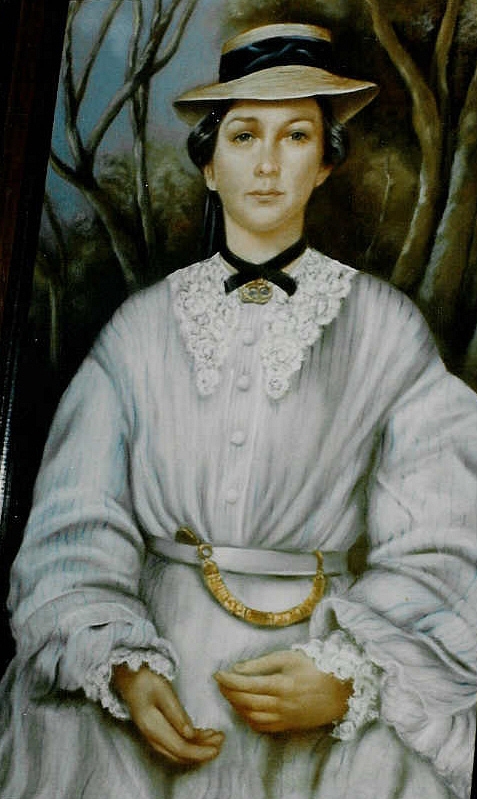 Emily Elizabeth Sanford was born 1832 in Knox Tennessee. She married 25 July
1845 to William L. Collett. They had 3 children.
1. Mary Olivia Collett
who married James Muse Dabbs
2. Eurilda Collett who married twice - A.
B.Hardy and Capt. William Speller Rhodes,
3. and only son, William L.
Collett, Jr. is listed in 1900 census as married 11 years but no wife listed on
the Madison County Census for him.
No buriel site found for Mary Olivia
Collett. Eurilda Collett and William Rhodes are buried in the Old Monroe City
Cemetery. William Collett is buried in Bastrop, Louisiana.
After
Collett's death, Emily Elizabeth married Byrd Ferrell Miller (28 May 1819 - 11
July 1871) on 1 Mar 1869 in Monroe, Louisiana and had a son Byrd Ferrell Miller,
Jr. age 6 months on the Ouachita Parish 1870 Census. In 1870 Emily Elizabeth was
38 and Mr. Miller 50. The following year Byrd Ferrell Miller died leaving Emily
Elizabeth with a young son. Byrd Ferrell Miller was buried in the Island
Cemetery (Bartholemew Cemetery) on the banks of the bayou just North of
Sterlington.
Emily Elizabeth married W. W. Grace 4 Aug 1873 in Ouachita
Parish. The groom was 45 and the bride 41. She and Mr. Grace lived only months
after their marriage. Emily Elizabeth died Nov 1873 Ouachita Parish Louisiana.
The 1880 census listed Byrd Ferrell Miller, Jr, age 10 living with his father's
younger brother, Elias Miller, in Terrebonne Parish.
Eurilda had at least
5 daughters.
1. Emma Hardy born in Morehouse Parish, Bastrop 1 Mar 1870
Died 5 Dec 1944 in Bastrop and is buried in Monroe City Cemetery. She married
George Collett Tisdale 1920 in Bastrop.
2. Olivia Hardy born 1870 died
1918 and is buried in Monroe City Cemetery. She married a Bryan.
3.
Mildred Hardy born 1973 Have no other information.
4. Adelia "Decie"
Rhodes born 1876 Died at age 15 at Mansfield School for Women.
5. Annie
Rhodes born 1881. Annie married Edward Briscoe Starsney. She lived in Swartz,
La. and died in 1953. Annie is buried Monroe City Cemetery.
Source and Contributor: Unknown
 The World for Women
Monroe Morning World, Thursday April 2, 1964 - 1B
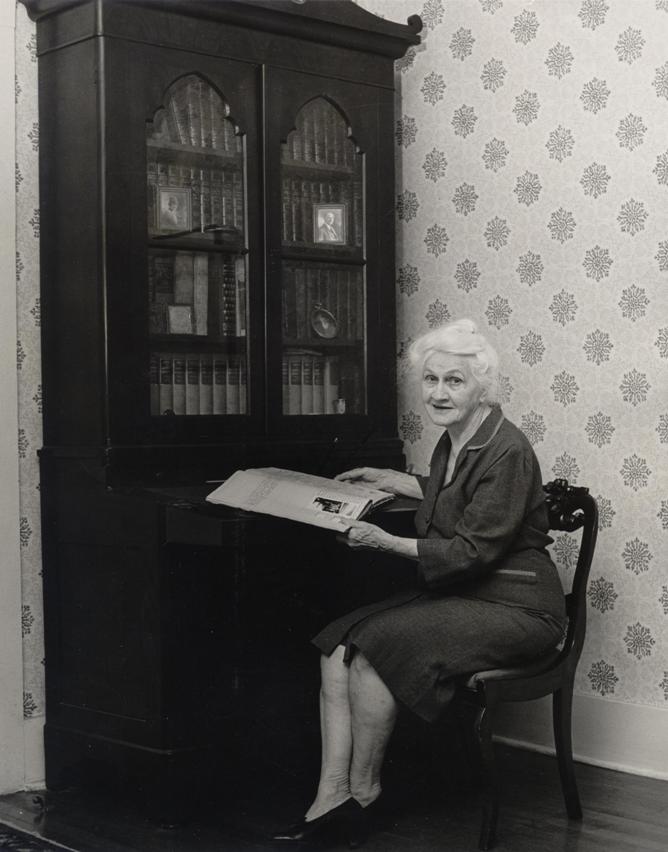
[a 4-1/2" by 6-1/2" photo of Mrs. Wooten sitting at her ancestral desk at
the age of 83 begins this newspaper article. The caption below the photo reads
as follows:]
May (LEE) WOOTEN is pictured in a familiar pose at the
ancestral desk, where she spends much of her time, engrossed in her hobby of
genealogical research. The volume she is studying is one which she has
personally compiled for her children, grandchildren and great grandchildren,
tracing all the family lines back through many, many generations. The handsome
desk was purchased in 1831 by her husband's grandfather and grandmother, when
they went by stagecoach to New York City on their honeymoon. It is one of the
marvelous antiques which furnish the restored Lower Parqoud Plantation house, at
2111 South Grand, which has been Mrs. Wooten's home since 1919.
The
Interesting World of Women
By Dottie Burns, World Society Editor
"Oh,
my goodness! What are you writing there? Put that pencil down and let's talk. I
want to know all about you."
And so it went during the delightfully
refreshing but all too short morning hours spent in the very good company of
Mrs. James R. Wooten, who at 83 is still so vitally interesting in everyone and
everything about her.
May Burch Lee Wooten is a strong willed but ever
gracious and captivating Southern lady and gentle woman whose own life loves and
marvelous good humor have overflowed to enrichen the lives of her family, her
friends and all who have had the good fortune to know her.
She is a
legend in her own time, and it seems almost dishonest to attempt to capture her
in anything less than the great American novel.
It isn't often that one
is privileged to enter into those most private and hallowed halls of a family,
who lives a daily dedication to its matriarch, so beloved is she by her
children, her grand children and her great grandchildren. From the eldest to the
very youngest, each has his own favorite tale, so filled with love, about
"Mayna," the name by which this spirited and gallant woman is so fondly known.
But the fun about these tales is that each is told as though speaking of a
contemporary, so ageless is their "Mayna," whose own unselfish love has inspired
this genuine devotion.
HERITAGE
The daughter of Mr. and Mrs. John
M. Lee, who families came to Louisiana from Virginia, Mrs. Wooten was born in
Farmerville in February, 1881. A few years later the family moved to Old
Trenton, which was later taken in by West Monroe.
After finishing at the
old Parish schools, she attended college, graduating from North Texas College at
Sherman, Texas. When this school later became part of Southern Methodist
University, she was presented with her diploma from that institution.
In
February, 1902, she became the young bride of James R. Wooten of Cuthbert,
Georgia and moved to his family home. It was here that she became entranced with
a whole new vestige of family history, which inspired her still active hobby of
genealogy. She was completely fascinated with the beautiful antiques and family
treasures that furnished the Wooten home, many of which were brought back to
Monroe.
In Georgia, the Wooten's first child, Anna Lee Wooten, now Mrs.
Elmer Slagle, was born. But Louisiana was in Mrs. Wooten's heart; it was home
and it beckoned her back. And back she came, eager to bring up her children in
the rich tradition and heritage of two fine old families.
In this she has
been most successful, as her family will testify. The Wooten children, in
addition to Mrs. Slagle, are the late John Lee Wooten of Shreveport and Maria
Brooking Wooten, now Mrs. Melville C. Vaughan of Aurora, Ohio. She has six
grandchildren and thirteen great grandchildren.
BEAUTIFICATION
You, don't have to look very far to see the influence Mrs. Wooten has had on
Monroe. It is in evidence in every direction in the planting which she inspired
to beautify her city. First president of the first garden club of Monroe, the
Monroe Garden Club, Mrs. Wooten led her fellow members on a drive to make Monroe
the garden spot of Northern Louisiana. Among their noteworthy undertakings was
the planting of the Magnolia trees, which still grace either side of Riverside
Drive along the river. Known then as Riverfront, Mrs. Wooten remembers the drive
as a rough dirt road filled with roots, but she was determined to substitute
with the beauty of planting that which was taken away by the building of the
levee.
The seawall on S. Grand Street was a thorn in Mrs. Wooten's side.
Even if she had to admit that the wall was perhaps a necessity, she didn't have
to admit that it was anything other than an eyesore. So with volunteer
hollyhocks from her own lovely gardens and an admonition from C. R. Tidwell,
Commissioner of Streets and Parks at that time, not to plant any trees or dig
any deep holes, Mrs. Wooten proceeded to plant hollyhocks all along the wall on
South Grand. Everyone was delighted. An idea was born and Mr. Tidwell organized
the City Beautification Board, of which Mrs. Wooten was chairman for eight
years.
Among the many other areas in the city, which have benefited from
this board were the public plantings on Lee Avenue, St. John Drive, the old Post
Office, Bernstein Park and the pine trees along Marie Place.
In her
campaign to make Monroe a garden spot, Mrs. Wooten also arranged to have
fourteen carloads of shrubbery shipped to her from the McIlhenny Jungle Gardens
near New Iberia. Some of the most beautiful camellias, azaleas and evergreens in
the city today came from those shipments, the first commercial shipment of its
kind to Monroe.
GENEALOGY
Mrs. Wooten's favorite inside hobby, the
perfect antithesis for her own lovely gardens, has been her work with genealogy.
What started as a simple but avid curiosity about the many branches which made
up her own family tree, became a hobby shared by the many people whose genealogy
she undertook to trace. Many women in Monroe today are members of the D.A.R. or
Colonial Dames because of Mrs. Wooten's untiring efforts in tracing their family
lineage. "I'm a record hound," said Mrs. Wooten, who still spends a great deal
of her time at her desk pouring over genealogical records. Recognized as an
expert in this field and a member of the Institute of American Genealogy, Mrs.
Wooten was often urged by her family to do this work as a business but she only
scoffed at the idea. It was a hobby, something she had to give to those she
loved, those whom she wanted to help.
PLANTATION HOME
Mrs.
Wooten's interest in family traditions and history brought her to notice the old
home on South Grand that had been built sometime in the very early 1800's by
Hippolite Pargoud as one of two plantation homes for his sons, Jean Francois and
Joseph Pargoud. The South Grand place, known as Lower Pargoud plantation, was
built on property that was part of a Spanish land grant, received by Jacques
Chole and John F. Girod and stretched from Apple to Thomas Streets. The property
had passed to the Pargouds through their uncle Monsieur Girod.
When Mrs.
Wooten first became interested in the home, it was in a bad state of repair, but
the place fascinated her and she dreamed of restoring it in all its original
beauty. Because, as she says, she had a most understanding as well as an
intelligent and charming husband, her dream came true in 1919, and Lower Pargoud
plantation house was hers. Its former beauty has been restored with very few
changes. The walls and most of the wide planked floors, the windows and the
shutters are those which Hippolite Pargoud put into the house 160 years ago.
Constructed of hand-hewn cypress with a 50-foot gallery across the front looking
towards the river, the home was originally built with the kitchen separate, as
was the custom in most antebellum homes. The bringing of the kitchen to be part
of the main structure is the only major change of the plan of the plantation
home.
Here Mrs. Wooten lives today, sharing it with her daughter and
son-in-law, Mr. and Mrs. Elmer Slagle. Here the Slagle children were privileged
to know this great lady during all their growing up years, for the family moved
in with "Mayna" when they were small.
Here Mrs. Wooten planned and built
her lovely formal gardens, so fitting for this home, steeped in historical
significance gardens filled with azaleas, camellias, magnolia fuscatas, sweet
olives, huge trees and southern shrubs that thrive at her touch and give the
true profusive beauty of age.
POLITICS
Mrs. Wooten declares she's
a homebody now, not really caring to go forth from her beloved homestead. But
that doesn't mean her mind is always at home where she is liable to be found at
her desk, pushing genealogical books aside to write to her congressman or
senator about issues of today, with which she keeps in daily contact.
Urged by her father who was a great believer in women's suffrage, Mrs. Wooten
was Vice President of the Louisiana Suffrage Association and personally brought
the late Senator Robert LaFollette Sr. of Wisconsin and Dr. Anna Shaw to Monroe
to speak on behalf of votes for women.
Always vitally interested in
politics with certain ideals and beliefs which she still feels it her duty to
fight for and against by getting out to the polls, Mrs. Wooten took an almost
violent interest of the late Miss Julia Wossman when she ran, unsuccessfully,
for the state legislature and again, when former President Eisenhower made his
first successful bid for the presidency.
Among Mrs. Wooten's other great
interests during her active years in Monroe, was the organizing of the Fifth
District Federation of Women's Clubs of which she was president.
She
helped organize the first Cotillion Club, which was the predecessor of the
Country Club here in Monroe, helping to put on the gala balls that marked the
social seasons.
In the thirties, she accompanied her husband, who was
then on the state highway commission when he went to Washington to get the
franchise for the Louisville Avenue bridge. Wasn't it exciting? "You mean about
the bridge?" she asked, "Oh, I don't know: I was too delighted to get to the
Library of Congress to think about bridges across the Ouachita." Mr. Wooten was
also postmaster of Monroe for many years.
In the early twenties, Mrs.
Wooten even took a turn as a realtor, a business into which she more or less
fell by chance, and she was most successful. But she gave up real estate and
auction bridge, she declared, upon the birth of her first grandchild, so sure
was she that something catastrophic was going to happen to this most precious of
all jewels. Finally she wore herself out on the club work too and found that she
was happy to stay at home with her gardens in good weather, her genealogical
books in bad.
It was her life, and it had been and is a good life, filled
with love for others and spiced with a generous helping of fun and foolishness
that has always been part and parcel of this remarkable woman.
Note: Mrs.
Wooten died June 30, 1968 in Monroe, Louisiana and is buried in Old City
Cemetery, Monroe, Ouachita Parish, Louisiana.
Contributed Dec 2006 by Hank Johns, a great-grandson of May B. (Lee) Wooten.
Copyright © 1996- The USGenWeb® Project, LAGenWeb, Ouachita Parish

This page was last updated
10/07/2026