Part of the LAGenWeb

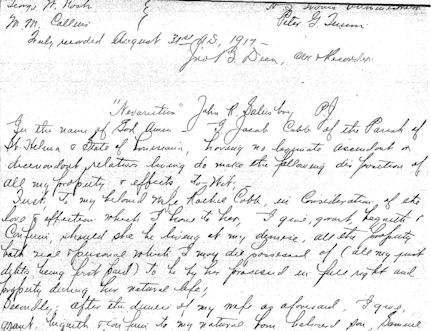 One of the greatest challenges in genealogy research is reading the
handwriting found in old documents. Census records, marriage certificates,
wills, deeds,
and handwritten letters often contain unfamiliar styles of penmanship.
Letters may look entirely different from those we use today, and faded ink,
damaged paper, and unusual spelling can make the task even more difficult.
Fortunately, with patience and a little practice, even the most difficult
handwriting can often be deciphered.
Start by studying the writer's
handwriting. Rather than concentrating on one difficult word, examine
the entire document. Look for familiar words and compare the way individual
letters are formed. A capital "S" might resemble an "L," while a lowercase
"r" may look like an "e." Pay particular attention to names, dates, and
commonly repeated words. Once you recognize how the writer forms certain
letters, other words often become easier to read.
Use context to help identify unfamiliar words. If you are struggling with a name, examine other records from the same family or community. Census records, church registers, cemetery inscriptions, and marriage documents may provide clues. Remember that spelling was not always consistent, particularly with surnames. A name might appear several different ways, even within records written by the same person. When possible, enlarge a digital image or adjust its brightness and contrast to reveal faint letters. Comparing the original image with a transcription can also help identify possible errors.
Never force a word to fit what you expect to find. It is tempting to interpret unclear handwriting as a familiar family name, but doing so can lead to mistakes that are repeated in future research. If a word cannot be confidently identified, mark it as uncertain and return to it later. Sometimes a fresh look, another document, or a second opinion is all that is needed. Learning to read historical handwriting takes practice, but every successfully deciphered word brings us one step closer to understanding the lives of our ancestors.
If you have questions or problems with this site, email the Parish Coordinator. Please to not ask for specfic research on your family.